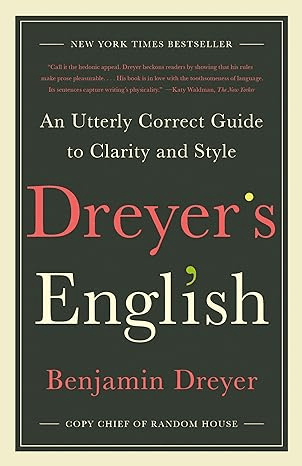
When a Random House copy chief puts pen to paper, writers should listen. Benjamin Dreyer’s Dreyer’s English: An Utterly Correct Guide to Clarity and Style isn’t just another grammar manual. It’s a whip-smart, laugh-out-loud style guide that reminds us that language is a living thing—and that writing should have both precision and personality.
As a trial attorney turned novelist, I’ve spent decades choosing my words carefully in and out of court, in pleadings, and now in fiction. Dreyer’s English hit me like a friendly editor with a red pen. It was sharp, clear-eyed, and comforting.
Here are a few takeaways that stayed with me:
1. “Only godless savages eschew the serial comma.”
Dreyer doesn’t just advocate for the Oxford comma; he crusades for it. As someone who appreciates clarity (and despises ambiguity in both law and literature), I’m with him. Consider this line:
I dedicate this book to my parents, Ayn Rand and God.
You see, the problem. I assume the author wasn’t claiming to be the Second Coming.
2. Cut “very,” “really,” and “just.”
Dreyer calls them “wan intensifiers.” These little words creep into our writing like polite houseguests, but they overstay their welcome. If a sentence doesn’t lose power when you cut it or remove it. If it does? Use a stronger word or verb.
“He was very tired,” becomes “He was exhausted.”
3. Know the rules. Break them on purpose.
Dreyer delights in calling out arbitrary grammar rules—like never starting a sentence with “And” or “But.” His message: know the conventions so you can break them with style, not ignorance.
4. “A copy editor’s job is to make sure you don’t sound like an idiot.”
If you’re a writer, you need an editor. Period. Dreyer reminds us that good editing isn’t about nitpicking—it’s about protecting your credibility.
As a novelist (and attorney), I know how small missteps can erode trust. Whether it’s a misplaced comma or a legal argument, readers and judges alike notice when we miss the details.
5. To Boldly Go… Ahead and Split That Infinitive
Dreyer calls out the infamous rule against splitting infinitives (like “to boldly go”) as unnecessary and outdated. The truth is, there’s nothing inherently wrong with placing an adverb between “to” and its verb. Sometimes, it’s even the most elegant and emphatic option.
“To go boldly” just doesn’t have the same punch as “to boldly go.” Ask Captain Kirk of the Starship Enterprise.
Dreyer reminds us: grammar exists to serve meaning, not the other way around. If splitting the infinitive sounds better and makes your point clearer—do it.
Final Thoughts
I have just scratched the surface here. Dreyer’s English isn’t a textbook—it’s a smart, funny, deeply knowledgeable gospel on writing by someone who has seen every writing sin and wants to save you from yourself.
If you’re a writer, a lawyer, or someone who just wants their words to land the way intended, I recommend this book. I hope it helps you with your writing and editing. manuscript.
 The Entity - A Novel
Leave a comment